
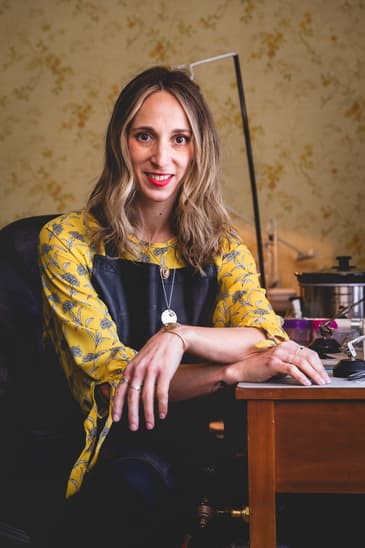

Welcome to "Shit That Goes On In Our Heads," an award-winning podcast celebrating being the 2024 People's Choice Podcast Award Winner for Health and the 2024 Women in Podcasting Award Winner for Best Mental Health Podcast! In this powerful second part of our conversation with Jaclyn Beckerman, we delve deeper into her inspiring mental health journey, exploring how her creativity and emotional resilience fuel her unique jewelry designs.
We want to hear from YOU! Share your feedback or leave a voice message here: https://castfeedback.com/67521f0bde0b101c7b10442a.
Guest Spotlight: Jaclyn Beckerman
Jaclyn is the founder of Jaclyn Nicole Design, which creates handcrafted jewelry to support emotional well-being and personal growth. Drawing inspiration from her own mental health journey, she designs with intention, offering pieces that serve as daily reminders of strength and mindfulness. Her work has touched the lives of spiritual seekers, therapists, and teachers alike.
Website: https://jaclynnicoledesign.com
Instagram: https://instagram.com/jaclynnicoledesign
Facebook: https://facebook.com/jaclynnicoledesign
3 Key Takeaways from This Episode
-
Healing Through Creativity: Jaclyn shares how crafting her jewelry is a meditative refuge and a tool for emotional balance.
-
Breaking the Stigma: A candid discussion about the power of vulnerability and the freedom found in embracing our mental health struggles.
-
Empowering the Next Generation: Jaclyn’s vision is to teach self-love to children and address societal challenges like bullying and anxiety.
Subscribe, Rate, and Review!
Don’t miss more inspiring episodes—subscribe now! If you loved this episode, leave us a review on your favorite platform or here: https://goesoninourheads.net/add-your-podcast-reviews.
Hashtags:
#MentalHealthMatters #AwardWinningPodcast #JaclynNicoleDesign #HealingThroughArt #PodcastFamily #BreakingTheStigma #JewelryWithMeaning
Tune in and discover the beauty of vulnerability and healing in Part 2 of Jaclyn’s remarkable journey.
********************************************************************************************************
If You Need Support, Reach Out
If you or someone you know is facing mental health challenges, please don’t hesitate to reach out to a crisis hotline in your area. Remember, it’s OK not to be OK—talking to someone can make all the difference.
- United States: Call or Text 988 — 988lifeline.org
- Canada: Call or Text 988 — 988.ca
- Worldwide: Find a Helpline
- Mental Health Resources and Tools: The Help Hub
Stay Connected with G-Rex and Dirty Skittles
- Official Website: goesoninourheads.net
- Facebook: @shltthatgoesoninourheads
- Instagram: @grex_and_dirtyskittles
- LinkedIn: G-Rex and Dirty Skittles
- Join Our Newsletter: Sign Up Here
- Merch Store: goesoninourheads.shop
Audio Editing by NJz Audio
[00:00:06] Hey there, listeners. Welcome to Shit That Goes Under Our Heads, the podcast where we normalize conversations around mental health.
[00:00:13] That's right. I'm Dirty Skittles and alongside my amazing co-host, G-Rex, we are here to share stories and tips from our incredible guests.
[00:00:21] Each episode, we deep dive into struggles and triumphs of mental health, offering practical advice and heartfelt support.
[00:00:28] Because no one should feel alone in their journey. Join us as we break the stigma and build a community of understanding and compassion.
[00:00:35] So tune in and let's start talking about the shit that goes on in our heads.
[00:00:43] So like when you're making your jewelry, do you like kind of get out of your own head and just put all your passion into doing that?
[00:00:51] And like all the other negative crap that is surrounding us?
[00:00:57] So...
[00:00:58] Yeah, it's always been like a refuge. It's like meditative in a sense, where you're kind of in the zone and just...
[00:01:06] Especially... So my favorite thing is working on new stuff. Like working on one of a kind pieces or a new collection. Like that's what lights me up the most. My... I don't always want to be the production line, like the manufacturer.
[00:01:19] My goal is to like grow my business into a brand that I can wholesale to retail my regular collection so that it can kind of reach more people and also reach people who need it.
[00:01:31] Like...
[00:01:31] Yeah.
[00:01:31] I think most... A lot of us who are at least in therapy or coaching, if nothing else, really want to like use the things. We just don't have the right tools to kind of make that progress that we want.
[00:01:44] And I think that it would be amazing to be able to reach more people who want that.
[00:01:50] And again, like I don't want to make the same thing 300 times. That gets boring for me.
[00:01:53] But I also really love doing one of a kinds and commissions and creating new collections. Like that's where I kind of get the most lit up.
[00:02:02] I was going to ask you about that commission. So people will tell you... What do they do? Like they tell you what they're struggling with or... How does the commission piece work?
[00:02:11] I mean, sometimes people specifically... If you go on my website, I guess for people listening, it's JacquelineNicoleDesign.com.
[00:02:19] So J-A-C-L-Y-N-D-E-S-I-G-N, DesignD-E-S-I-G-N.com. That was too much to spell.
[00:02:27] It's like you're losing me.
[00:02:29] There's a custom commission, like consultation one.
[00:02:36] You can see pictures.
[00:02:37] So it depends.
[00:02:38] And sometimes I've had... I have one client who's been like a repeat client and he would make up these stories for his kid that were incredible.
[00:02:46] Like literally like fantasy stories, like whole different characters and dialogues and things that happen.
[00:02:53] And I would then like go and create pieces that represented each of those stories and stuff.
[00:03:00] And that was super cool.
[00:03:01] Or it could be someone like I have a customer who wanted an eagle because they're really significant to her.
[00:03:07] She's actually an artist and draws these amazing angel wings.
[00:03:09] So she'll do like memorial pieces for people with angel wings or that person they lost or whatever.
[00:03:15] So she wanted an eagle.
[00:03:16] And it's actually one of my favorite pieces of me.
[00:03:18] It's like awesome.
[00:03:19] But it's like three layers, like three different metals.
[00:03:23] And it's very intricate.
[00:03:24] It's like a flying eagle.
[00:03:25] So the arms go out.
[00:03:27] It's super dope.
[00:03:28] But so it depends what the person wants.
[00:03:29] But that's fun for me.
[00:03:31] So sometimes...
[00:03:32] And then there have been times where it's like, oh, like I want my...
[00:03:35] It's something that represents this for this person.
[00:03:37] Like I want a reminder to kind of love themselves or whatever it is.
[00:03:41] And I remember that when I created this part that had a key kind of through the middle in a different color and then wrapped around it.
[00:03:49] And then it also had some gemstones.
[00:03:52] So it's very much then open to whatever the person is looking for.
[00:03:57] But usually I like...
[00:04:00] I enjoy that.
[00:04:00] Not everybody likes commissions.
[00:04:01] Not everybody likes doing something that someone else has input on.
[00:04:05] I think it's super fun to kind of whittle it down back and forth of like what it is and what you're looking for or how much you want, you know.
[00:04:13] And like usually I'll send some sketches or some ideas.
[00:04:16] Yeah.
[00:04:16] The necklaces you are wearing, did you design for yourself?
[00:04:21] Like is that...
[00:04:21] These are ones I regularly do.
[00:04:23] So the one was the sand drop one.
[00:04:25] The other one I'm currently wearing is the knot.
[00:04:27] It's a winding knot.
[00:04:28] So it's very different than like your typical knot necklace.
[00:04:31] I know it's kind of hard for you to see.
[00:04:32] But the idea with that collection...
[00:04:34] So most of them have a ring, earrings, necklace, bracelet.
[00:04:37] The idea with that collection is just like life takes a lot of twists and turns, right?
[00:04:42] It's complicated.
[00:04:43] It gets knocked off course, turned around.
[00:04:45] Sometimes in ways we really don't want or like understand at the time.
[00:04:49] But when you look at the bigger picture, ultimately, those things are what create something really beautiful.
[00:04:54] Your unique strengths, experiences, perspective.
[00:04:57] You wouldn't have those had you not been through those things, right?
[00:05:01] Right?
[00:05:02] So the idea though is that it be a reminder when you're going through the changes and the challenge and the stuff feels like it's going wrong to pause and like touch it and ask yourself,
[00:05:13] why is this happening for me instead of to me?
[00:05:16] What's the good that's gonna come out of it?
[00:05:18] Because we know what choice does, right?
[00:05:20] They don't get better.
[00:05:21] We always eventually get to a better place because of those things.
[00:05:25] And we just can't see the forest for the trees at the time.
[00:05:29] But the sooner that we kind of identify, like I said, when I left that relationship and I said, I need to focus on self-love.
[00:05:35] But identifying that then is what helped me get through.
[00:05:40] That's the thing that helped me persevere and helped me like stay sane and helped me heal and helped me grow.
[00:05:50] Because I early on identified like this is where this is going to take me because it has to be for a reason.
[00:05:55] And it has to make my life better.
[00:05:57] This can't be for nothing.
[00:05:58] And then my life just sucks.
[00:05:59] Like that's not okay.
[00:06:00] I'm not going to allow that.
[00:06:01] That's not the life I'm going to stand for myself.
[00:06:04] And I think it's the same with any, even the smaller things.
[00:06:07] When you, the sooner you can identify where you're going and how this is going to make your life better, the sooner you see opportunities to move there.
[00:06:17] Yeah.
[00:06:18] Yeah.
[00:06:18] That makes sense.
[00:06:19] Amen.
[00:06:20] Amen.
[00:06:34] Like I get to listen to amazing stories like yours and that will help somebody else and, you know, kind of figure out their own shit.
[00:06:43] Yeah.
[00:06:43] Because, you know, life is messy and we all have messy heads and depression sucks.
[00:06:49] Depression sucks.
[00:06:50] Yeah.
[00:06:51] Yeah.
[00:06:51] Yeah.
[00:06:52] Well, also I think we're so, it's so exasperated by the fact that it's always been so taboo to talk about.
[00:07:02] And so many people aren't willing or don't want to talk about it.
[00:07:05] They like want to be very layered and they don't want you to know their inner shit.
[00:07:11] And I'm like, I'm not interested in that.
[00:07:13] That's so much work.
[00:07:14] Like, why wouldn't it be easier to just be like, these are the things I suck at.
[00:07:19] These are the things I'm good at.
[00:07:20] This is what I'm working on.
[00:07:21] This is what I'm having trouble with.
[00:07:22] Like, wouldn't you prefer that kind of relationship?
[00:07:25] Because I would.
[00:07:26] It's really hard for me to relate to people who just want these very surface superficial conversations.
[00:07:31] Because I'm like, that's so exhausting.
[00:07:34] It could be because I'm neurodivergent too.
[00:07:35] I don't know.
[00:07:36] To me, that's exhausting.
[00:07:37] Yeah.
[00:07:38] No, you just said like that just was like an aha moment because recently I have stopped being like before I would keep a lot of the shit to myself.
[00:07:49] Right.
[00:07:50] Like this is my baggage.
[00:07:51] This is what I'm going through.
[00:07:52] But it really outs like be outspoken about it.
[00:07:55] But since doing this podcast, I think that's what has changed or what this podcast has changed about me is I no longer hide that.
[00:08:02] So like if somebody is going to ask me like, hey, how are you doing?
[00:08:04] I'm going to I'm going to tell you how I'm doing.
[00:08:06] You know, I'm not going to be like, yeah, I'm.
[00:08:07] Great.
[00:08:08] No, I'm like, yeah, I'm struggling today.
[00:08:10] Today sucks, you know, but I'll be fine.
[00:08:12] Or like, you know, just something like that has been different.
[00:08:17] So, yeah, I make you feel different.
[00:08:20] Yeah, because it is a lot of work to just put up a mask.
[00:08:25] Bullshit.
[00:08:26] Yeah.
[00:08:26] Like it's just bullshit.
[00:08:27] And it's not really serving me if I'm just putting up bullshit.
[00:08:31] You know what I mean?
[00:08:32] So how do you feel then when you do just share it?
[00:08:35] Oh, like free in the moment.
[00:08:37] Because I'm like, you know, I'm not stressing about it.
[00:08:39] I'm like, OK, well, got that out of the way.
[00:08:42] Moving on.
[00:08:44] But I'm just the same thing we tell our kids like we you're holding that shit in doesn't make it go away.
[00:08:49] It makes it bigger and stronger.
[00:08:50] Yeah.
[00:08:51] When you talk about it and like let it out in an appropriate way, not in a screaming, taking it out on people way.
[00:08:58] But in a like, because you're trying to hold it in.
[00:09:01] Yeah.
[00:09:01] But in a like, let me just tell you what's actually going on.
[00:09:03] You actually feel better.
[00:09:05] Yeah.
[00:09:05] Like, and then you can like that's what intimacy is.
[00:09:09] Yeah.
[00:09:09] You know, that was the one thing I remember from the couples therapist we went to that I did like that she would say.
[00:09:14] She'd be like, intimacy is into me, you see.
[00:09:17] And I was like, that's really helpful.
[00:09:19] Yeah.
[00:09:20] Like, sharing that in our world.
[00:09:22] Yeah.
[00:09:22] Yeah.
[00:09:23] And I was like, I didn't know that.
[00:09:26] I didn't know that's what I was supposed to be.
[00:09:28] You know, like, not just giving, but also expecting.
[00:09:33] And that's the part for me that was a light bulb.
[00:09:35] Like, I could share, but maybe if this other person isn't also sharing, like, that's not intimacy.
[00:09:41] Right.
[00:09:42] Yeah.
[00:09:42] And that was really, like, eye-opening to me.
[00:09:46] Yeah.
[00:09:46] But I think, for me, I feel like that was my ADD too.
[00:09:50] Like, I used to feel, like, I grew up being told very often, like, what's wrong with you?
[00:09:56] Why can't you be like this?
[00:09:58] Being screamed.
[00:09:59] Like, I mean, my mom also undiagnosed and very poor emotional regulation.
[00:10:03] So she would, like, go from zero to 90 in, like, upset or anger or, like, freak out very immediately.
[00:10:13] And then when we first moved here, I saw her do it with my kids.
[00:10:15] And it was, like, it would make me kind of very triggered and angry.
[00:10:19] And then I'd be yelling at her while I'm trying to talk to them.
[00:10:22] Like, you don't need to listen to that.
[00:10:23] Like, that's not.
[00:10:24] Yeah.
[00:10:25] And, like, I'd talk to them later too and be like, you know what?
[00:10:28] Like, we are working on it.
[00:10:30] Like, we're all.
[00:10:31] But grandma doesn't know how to do that.
[00:10:33] You know, like, she's spent her whole life.
[00:10:34] She has all her own stuff that she went through as a kid that she's never dealt with.
[00:10:38] And, like, she's not able to handle that.
[00:10:42] That doesn't mean she's right.
[00:10:43] That doesn't mean.
[00:10:44] So, like, I need you to know the things she says when she says stuff.
[00:10:47] Like, that's not right.
[00:10:48] Like, that she's wrong.
[00:10:49] And you don't need to believe it.
[00:10:51] And then I was to my therapist the other day.
[00:10:54] I'm like, I'm glad I at least have been able.
[00:10:57] Like, I'm there for them, right?
[00:10:59] But I'm like, my poor inner child who had no one there for them.
[00:11:02] No.
[00:11:03] I was just thinking that.
[00:11:05] Like, had no one there.
[00:11:06] And I'm like, that's so sad.
[00:11:11] That's so heartbreaking.
[00:11:13] It is.
[00:11:14] And the thing is, like, my mom's not malicious.
[00:11:17] She really isn't.
[00:11:18] Like, she is not able to see or understand the impact and the damage.
[00:11:26] And really, truly isn't.
[00:11:28] And it's infuriating to me.
[00:11:29] Because I'm like, why is it that I can grow and learn that and you can't?
[00:11:32] But she can't.
[00:11:33] And that becomes really tricky.
[00:11:36] Because I'm like, this is not, like...
[00:11:38] Yeah.
[00:11:39] Yeah.
[00:11:39] It's so much better since we were able to kind of at least have our own space now.
[00:11:43] Yeah.
[00:11:44] Our relationship's gotten better, too.
[00:11:45] That's good.
[00:11:46] But it's tricky.
[00:11:47] This is a mini meditation guided by Bombas.
[00:11:51] Repeat after me.
[00:11:53] I'm comfy.
[00:11:54] Comfy.
[00:11:54] I'm cozy.
[00:11:55] Cozy.
[00:11:56] I have zero blisters on my toes.
[00:11:58] Blisters.
[00:11:59] And that's because I wear Bombas.
[00:12:00] The softest socks, underwear, and t-shirts that give back.
[00:12:04] One purchased equals one donated.
[00:12:06] Now go to bombas.com slash listen and use code listen for 20% off your first purchase.
[00:12:12] That's B-O-M-B-A-S dot com slash listen and use code listen at checkout.
[00:12:22] Yeah.
[00:12:23] So that kind of leads into a question I was going to ask you, which I like to ask.
[00:12:26] If you could go back in time to a younger version of yourself, what would you say to yourself then as like a bit of advice?
[00:12:33] And how old are you when you go back in time?
[00:12:35] God.
[00:12:35] So I will say I've probably blacked out a lot of my childhood.
[00:12:41] And I think that's partly ADD, partly trauma.
[00:12:45] I'm not sure.
[00:12:47] I know it's pretty common with people with ADHD because working memory.
[00:12:51] But interestingly, like some long-term memories.
[00:12:53] I'll be really specific.
[00:12:56] But yes, it would have to be early, right?
[00:13:02] Like I probably don't even, I couldn't even tell you the age I can probably say at least four.
[00:13:10] And I guess that I'm, that like you're enough and that there's nothing wrong with you.
[00:13:19] You know, like we all, I say now to my kids and to others, like we all have shit.
[00:13:24] Like we all have things we struggle with.
[00:13:26] We all have some things that are harder for us and easier for others and vice versa.
[00:13:30] Right?
[00:13:31] Like ADHD also is not all that, right?
[00:13:35] It's most, many people with it, like very creative.
[00:13:39] We're very innovative.
[00:13:40] We're like very fast thinkers.
[00:13:44] We come to solutions really easily.
[00:13:45] We're very, most, many of us are very empathetic.
[00:13:48] There's a lot of great qualities to that too, just like everything else.
[00:13:52] All, I think our brain, everyone's brains are just, we're different.
[00:13:56] And I kind of feel like the neurotypical thing is bullshit and all around.
[00:14:02] Like, I don't think anybody's typical either.
[00:14:04] I think people are hiding stuff.
[00:14:07] Like we were talking about before, like you, people just don't share those in our worlds.
[00:14:11] Yeah.
[00:14:11] But I don't, I feel like most people struggle and partly because of that, because we were all taught
[00:14:17] from a young age that you should.
[00:14:19] And that you shouldn't make others uncomfortable with your feeling.
[00:14:23] Like we grew up in generations that like, we're told to shut up and behave and that you're like,
[00:14:29] you shouldn't feel this way.
[00:14:31] And it's not a big deal and suck it up.
[00:14:35] And all of that stuff is so damaging because we learned not to trust ourselves.
[00:14:40] We learned not to trust our feelings.
[00:14:43] And also learned not to trust other people.
[00:14:46] Yeah.
[00:14:47] Because our feelings aren't safe with them.
[00:14:49] Yeah.
[00:14:50] You know?
[00:14:51] So true.
[00:14:51] And I think most, at least like millennials and older at minimum experience that.
[00:14:58] Yeah.
[00:14:58] I don't know about what's, Gen Z is below millennial, right?
[00:15:01] Yeah.
[00:15:02] Like, I think they're doing better.
[00:15:04] They've still got shit.
[00:15:05] There's a lot of anxiety there, but they're also the first ones that have never not had
[00:15:08] electronics and phones in their faces nonstop.
[00:15:12] So it's also a challenge.
[00:15:15] But yeah, I feel like kids today, like I'm grateful that our kids are at least growing
[00:15:22] up in a world that is more inclusive.
[00:15:26] Yes.
[00:15:27] But not just inclusive in the sense of how people are like, oh, because people with like
[00:15:31] neurodivergent versus typical, but more so that people are okay with other people
[00:15:37] having their stuff and being who they are.
[00:15:42] And, you know, having different accommodations or having different stuff they need.
[00:15:46] Like that isn't such a big deal in today's world for our like youth.
[00:15:51] And I think that's amazing.
[00:15:53] Yeah.
[00:15:53] That's actually something I'd love to kind of contribute more to.
[00:15:56] Yeah.
[00:15:57] I had an idea for it.
[00:15:58] So one day when my brand blows up because everybody buys all my things and I have the
[00:16:03] money to do so, I want to also, I would love to create a use line.
[00:16:07] I already named it.
[00:16:08] It would be called Mavi Nicole because Maddie and Via are my daughters, Madeline Olivia.
[00:16:13] Yeah.
[00:16:14] And I'm Jacqueline, so Jacqueline Nicole.
[00:16:16] But it would be more like preteen teen kind of focused style wise and more on the stuff that
[00:16:22] they like struggle with.
[00:16:24] But what I always want to do, like have thought about that I'd love to do is take a percentage
[00:16:29] of those sales to put it towards kind of creating some kind of programming, whether it's video
[00:16:34] programming or some workshops or something that can easily be implemented in like elementary
[00:16:40] schools.
[00:16:40] That's more focused on teaching kids to like themselves, to love themselves, to know that
[00:16:46] they're enough.
[00:16:46] Because for me, that's why that's our biggest issue.
[00:16:50] It's not that I'm getting along with others.
[00:16:52] It's that they don't like themselves and that's why they don't get along with others.
[00:16:55] And I think it would solve a lot of the school shooting issues.
[00:16:58] I think it would solve a lot of the bullying issues.
[00:17:00] I think if kids liked themselves and loved themselves, they wouldn't be taking out their
[00:17:05] fear and trauma and hurt and pain on other kids.
[00:17:08] I agree.
[00:17:10] It blows my mind that we don't have that now.
[00:17:13] Like I'm like, how the fuck am I in my 40s just now figuring this shit out?
[00:17:18] And it's something that I've struggled with for my life.
[00:17:21] You know what I mean?
[00:17:21] Like I want my son to have those troubles and know that about himself.
[00:17:26] So I agree.
[00:17:28] I think it's the same thing I said earlier.
[00:17:30] Yeah.
[00:17:31] But again, I think it's what I was saying a little bit ago too, is we grew up with parents
[00:17:36] and our parents, like we grew up in generations where everything was expected that you didn't
[00:17:43] share this.
[00:17:43] Therapy was very like taboo.
[00:17:45] It was like very judged and stigmatized.
[00:17:49] Like those things have changed for our generation.
[00:17:52] And I think that at least the stigma around therapy, like we all started going to therapy.
[00:17:56] But also the other thing I think has had an impact is that we have unprecedented access to information.
[00:18:03] Like our parents, their parents, they didn't have a modicum of access to the information we do because of the internet.
[00:18:12] And we have access to reliable sources.
[00:18:15] Not everyone seeks those.
[00:18:17] However, we have access to them, like to EPUBs, to like to study, to professionals that can tell us like this is normal or this is not normal.
[00:18:28] Or this is like, or not typical.
[00:18:31] Like, or this is something you can get help for.
[00:18:34] Or if this is something you struggle with, like you can get help for this and it's okay.
[00:18:39] Yeah.
[00:18:39] And here's the resource.
[00:18:41] Yeah.
[00:18:41] Right.
[00:18:41] They didn't have any of that.
[00:18:43] So as much as it's infuriating because a lot of our trauma is because of them,
[00:18:48] that was theirs.
[00:18:50] And they didn't have the access to how to do differently, I think.
[00:18:54] Whereas it sucks to be the one having to break those generational curses and shit because it's so much work and it's so hard and it's so painful.
[00:19:04] But at least we have the access to do it.
[00:19:07] And I think that's why they didn't.
[00:19:09] Because they'll be able to do this.
[00:19:10] Like they didn't know better.
[00:19:11] They didn't have, the parenting advice then was like, just smack them.
[00:19:16] Yeah.
[00:19:17] Give them something like, rub a test and they'll go to sleep.
[00:19:20] Like, there were freaking ads when we were kids that were like, do you know where your kid is?
[00:19:25] It's nine o'clock.
[00:19:26] Like, why don't you know where your fucking kid is at nine o'clock?
[00:19:29] How is that normal?
[00:19:30] Why do we need ads to tell you, to remind you to look for your children?
[00:19:34] That's not normal.
[00:19:37] So like they have very different messaging than we have gotten.
[00:19:42] And now we healing ourselves and understanding and seeing the impact and seeing the difference it makes are delivering that to our kids.
[00:19:50] And I think that's the difference.
[00:19:51] I think that's why their social awareness with one another with this kind of stuff is so different.
[00:19:59] Yeah.
[00:20:00] But I think we have a really far way to go, right?
[00:20:02] Like we're still not teaching kids what I said.
[00:20:04] We're not teaching kids to love themselves.
[00:20:06] We're not teaching kids that they are enough.
[00:20:09] We're teaching them how to better interact with other kids.
[00:20:11] Right.
[00:20:12] But we're not necessarily delving to like the deeper root because not all parents are us.
[00:20:18] And like in millennials and Gen Z too, not all the people that they still are in their parents' mindset of like, it's fine.
[00:20:24] Everything's fine.
[00:20:24] Like, fuck off.
[00:20:25] Right, right, right.
[00:20:26] Just keep going.
[00:20:27] And then kids are going to get the outset of that.
[00:20:29] Yeah.
[00:20:30] Yeah.
[00:20:30] I love that.
[00:20:31] So I like the idea of delivering it at schools.
[00:20:33] Go ahead.
[00:20:34] Yeah.
[00:20:34] No, that's okay.
[00:20:40] What's been the hardest lesson you've had to learn in your life so far?
[00:20:44] Hard.
[00:20:45] Hard.
[00:20:45] I mean, the hardest lesson, the hardest lesson is probably one that I still work on now.
[00:20:55] And it's, but that I already touched on.
[00:20:58] And it's really loving, like learning to love myself and to know that I'm enough.
[00:21:02] Because as much as I've done a lot of work on that and grown a lot around it, that's just still pops up.
[00:21:09] Like in friendships and social things, like I was bullied a lot as a kid.
[00:21:14] So I have a very automatic place of going to something's wrong with me.
[00:21:18] It's my fault.
[00:21:19] Why, why doesn't this person like me?
[00:21:22] Or why am I not good enough for this?
[00:21:23] Or whatever it is.
[00:21:25] Like that's where my automatic, like my brain triggers and synopsis goes there.
[00:21:30] And it's, it's some of them are, even when I heal some, like there's other aspects that show up.
[00:21:35] And then I get stuck in them for ages.
[00:21:38] And I'm getting there.
[00:21:39] I've had some like realizations lately that have been great.
[00:21:42] Like I approached dating in the way of, I'm not that interested.
[00:21:47] Like, I don't care.
[00:21:48] I'm happy.
[00:21:48] I'm good on my own.
[00:21:50] And it's closed off to it.
[00:21:52] But I, it would take a lot for me to be interested.
[00:21:56] And my biggest thing is like, you need to have been through therapy or in therapy and healed or working on your own shit.
[00:22:03] And, but for me, like whatever anyone else wants, that's fine.
[00:22:07] I'm not saying everyone has to do that, but I am not interested in dating someone who has not done that because otherwise that's just getting taken out on me or my kids.
[00:22:15] And I have no interest in that.
[00:22:18] It's too much work.
[00:22:19] I don't want to, I am not your savior.
[00:22:21] Like I'm not doing it.
[00:22:23] I'm not doing it.
[00:22:23] It's not for me.
[00:22:25] And I, like, I have shit still.
[00:22:29] I'm still working on mine, but I expect the other person to be doing the same.
[00:22:34] Right?
[00:22:34] Like nobody's perfect.
[00:22:35] That's fine.
[00:22:36] But I need self-awareness and I need responsibility for your own triggers and your own crap.
[00:22:42] So I still struggled with friendships of those like deep seated feelings.
[00:22:47] And I just, like a week ago, had this amazing insight that I was like, oh my God, what?
[00:22:52] Why approach friendships this way?
[00:22:54] Like why not approaching friendships the same way?
[00:22:57] Like, I don't need this person to like me or to be my friend.
[00:23:01] Rather, like, are you the type of friend I want in my life?
[00:23:05] Like, is this worth me investing my time into and effort?
[00:23:08] And it doesn't mean I can't be kind and nice and friendly and whatever with people.
[00:23:13] But that like, why am I seeking close relationships with people who aren't able to provide the kind of relationship I want?
[00:23:20] And that's okay if they can't.
[00:23:21] We can still be friends in a different way, but like, or not.
[00:23:25] If I'm, maybe we're just, you know, there's no chemistry and that's okay too.
[00:23:28] Yeah.
[00:23:29] And that's new.
[00:23:30] But these are, for me, I think this is my lifelong lesson that it has been the hardest thing for me to learn.
[00:23:35] Because I had a lot of re, like, what do you say?
[00:23:44] Like a reinforcement in my childhood that I, that something was wrong with me and I was not enough.
[00:23:50] And that I was wrong and that I wasn't okay.
[00:23:53] And I feel like throughout my whole childhood.
[00:23:56] So it's, it's burdensome sometimes.
[00:24:01] Yeah.
[00:24:01] And frustrating.
[00:24:02] Yeah.
[00:24:03] But I also know that the more space I get around it and the more I grow around it, the happier I feel and the better my life gets.
[00:24:11] So that's my thing.
[00:24:13] And the more you practice it and work on it, it'll get easier one day.
[00:24:16] And yeah.
[00:24:17] I love that.
[00:24:18] This has been awesome.
[00:24:20] Thank you.
[00:24:21] Thank you.
[00:24:21] Thank you for joining us today.
[00:24:23] This was such an incredible session.
[00:24:27] Yeah.
[00:24:27] Do you want to give your sites out one more time for anybody who's looking to purchase a piece of this jewelry that you're creating for this?
[00:24:35] For sure.
[00:24:37] It's, so my website is JacquelineNicoleDesign.com.
[00:24:41] So J-A-C-L-Y-N-I-C-O-L-E-C-E-S-I-G-N.com.
[00:24:46] See, it was easier when I did them slower.
[00:24:48] And then basically my socials are kind of the same.
[00:24:50] So it's at JacquelineNicoleDesign on Instagram, Facebook, I think Pinterest too.
[00:24:56] And TikTok.
[00:24:58] I am going to not lie.
[00:25:00] I am like, I try with social media, but I am not always consistent because it's very difficult to manage all those things.
[00:25:07] But I'm most active on Instagram probably.
[00:25:11] But I have a Shopify site.
[00:25:13] So you can shop directly on my website as well.
[00:25:17] But before I forget, there was one piece that you keep everything, what you keep saying keeps making me think of.
[00:25:22] What?
[00:25:23] So it's my spinner ring.
[00:25:24] I just think it would support you.
[00:25:26] But it's actually my best seller.
[00:25:28] It's probably the thing I've sold the most of in the entire time I've been doing this.
[00:25:31] But they're a little different because they're very dainty.
[00:25:34] Usually they're very thick and utilitarian looking and I don't like them.
[00:25:38] But they have two bands.
[00:25:40] There's too much light here for you to really see.
[00:25:41] But the idea with it is that whenever you catch yourself in your head, obsessing, ruminating, playing something out, imagining how it'll go, feeling negative emotion, like you're frustrated, anxious, irritated, disappointed, or whatever.
[00:25:54] You spin it.
[00:25:56] But there's a twist.
[00:25:57] So specifically with the promise to yourself that before you stop spinning, you refocus your attention on the present moment, the one you're currently in.
[00:26:06] I like that.
[00:26:07] Because it's not actually happening.
[00:26:08] Everything else is thoughts in your head that you're thinking about things happening, right?
[00:26:13] Yeah.
[00:26:13] They're not.
[00:26:14] However, they still elicit real feelings, like really real tangible feelings.
[00:26:19] And no one really teaches us that.
[00:26:21] So we don't really know what to do with it or we don't do anything about it.
[00:26:24] And then we end up going through our day on top of them, like filtering everything that happens through them.
[00:26:29] Yeah.
[00:26:31] Nothing happened.
[00:26:31] We just kind of thought about shit.
[00:26:33] It made us feel bad.
[00:26:34] And now we're looking at the world from that.
[00:26:36] Yeah.
[00:26:36] And then by the end of the day, like our whole day goes that way, right?
[00:26:39] Yeah.
[00:26:39] So there's what the practice...
[00:26:41] And regardless of whether you get the right, the practice is awesome.
[00:26:44] So you can use it either way.
[00:26:45] While I'm spinning, what I usually do is I start naming all the stuff I see.
[00:26:49] It could be anything of sense.
[00:26:50] I find see the easiest.
[00:26:52] Because if an emotional scale to the floor to the ceiling is worth the best, you don't have to get to the ceiling.
[00:26:58] It's not necessary.
[00:26:59] You just need to get higher.
[00:27:01] Yeah.
[00:27:02] And when you feel better, you have access to those better feeling stuff.
[00:27:06] So what I do is I'll be like, there's a brown couch.
[00:27:09] There's a brown pillow with beige lines on it.
[00:27:12] There's gray sweater.
[00:27:13] There's a cat tower that's blue and fuzzy.
[00:27:16] And then it's got like cat scratching things that are beige.
[00:27:18] And there's a little basket that's pink and purple.
[00:27:22] And there's a coffee table.
[00:27:24] And it has...
[00:27:25] It's like, you know, brown wood.
[00:27:28] And then there's kind of gray metal framing thingies on the bottom.
[00:27:33] And for me, it's easiest to just do what I see because I don't have to think about it.
[00:27:36] Right.
[00:27:37] But I promise you within a minute or so, you physiologically start feeling the difference.
[00:27:43] Like it lifts you out of that shit, like in that space that you were obsessing about and those feelings.
[00:27:49] And you genuinely feel better.
[00:27:50] And your day will go...
[00:27:52] The more...
[00:27:52] And it's just practice.
[00:27:53] Like there's no right or wrong.
[00:27:54] But the more...
[00:27:55] A lot of the times I like...
[00:27:57] I notice it and then I'm like, oh shit, I'm doing the thing.
[00:27:59] So then I do it.
[00:28:01] Right?
[00:28:02] Yeah.
[00:28:02] Or sometimes I'm just fiddling with it because that's fun too.
[00:28:05] And when I recognize that I'm fiddling with it, I check in and I'm like, am I doing...
[00:28:10] Like am I obsessing about something?
[00:28:11] And plenty of times you are.
[00:28:13] Yeah.
[00:28:13] And it's just the more you practice, the easier it gets to be like, that's not happening.
[00:28:17] That's not happening.
[00:28:18] It might never happen.
[00:28:19] I'm probably like zoom planning.
[00:28:21] Like it's not happening.
[00:28:23] And this moment is...
[00:28:24] And there's nothing wrong right now.
[00:28:26] Right.
[00:28:26] There's so much freedom in it.
[00:28:28] Like there's been so much freedom and peace and ease and joy in recognizing that this moment
[00:28:33] is fine.
[00:28:34] And I can be in it and I can enjoy it.
[00:28:36] Yeah.
[00:28:36] I love that.
[00:28:37] Thank you for that.
[00:28:38] What you said made me think I needed to share it.
[00:28:41] Oh, thank you for that.
[00:28:41] I appreciate it.
[00:28:43] For sure.
[00:28:43] I appreciate it.
[00:28:44] Thank you.
[00:28:45] This has been wonderful.
[00:28:46] Yeah.
[00:28:46] Yeah.
[00:28:47] I can't wait to get on that site.
[00:28:49] Yeah.
[00:28:49] I'm going to go out there now and see what I can get.
[00:28:52] But yeah, I appreciate your story.
[00:28:54] I appreciate your insight.
[00:28:56] And just being vulnerable with us and sharing.
[00:28:59] No, this was amazing.
[00:29:00] I would be happy to come on again one day if you ever want.
[00:29:03] Like I'd love to.
[00:29:03] This has been so much fun.
[00:29:04] We love it.
[00:29:05] You've become part of the family.
[00:29:07] So for sure we'll have you back.
[00:29:08] Yay.
[00:29:08] You're my good people.
[00:29:10] Yay.
[00:29:10] Like I think the way what you said is the same for me.
[00:29:13] Talking about this stuff is so uplifting.
[00:29:16] Yeah.
[00:29:17] And talking to people who are also aligned with it and who are working on their shit.
[00:29:22] Like it helps shift things in you having those conversations.
[00:29:28] And not having them keeps you where you are.
[00:29:32] Great.
[00:29:33] Amen.
[00:29:34] Amen.
[00:29:35] Hi, all.
[00:29:36] Thank you so much for listening to this episode.
[00:29:38] I'm G-Rex.
[00:29:39] And I'm Dirty Skittles.
[00:29:40] Don't forget to subscribe, rate, and review this podcast.
[00:29:43] We'd love to listen to your feedback.
[00:29:46] We can't do this without you guys.
[00:29:49] It's okay to be not okay.
[00:29:51] Just make sure you're talking to someone.
[00:30:25] Hey, everybody.
[00:30:25] I'm Trevor Sick.
[00:30:26] I'm a host of the PFF NFL show here to tell you what you can find on all of our shows throughout the week.
[00:30:31] On Mondays, we have the Grade Release Show where myself and Donald Wasserman break down every single game that you just saw in the NFL.
[00:30:37] On Tuesdays, we have the Quarterback Breakdown with Seth Galena.
[00:30:40] On Wednesdays, we've got the Rookie Review with John Ledyard and the preview for the upcoming week in the NFL.
[00:30:46] So make sure you are subscribed to the PFF NFL show wherever you get your podcasts.