
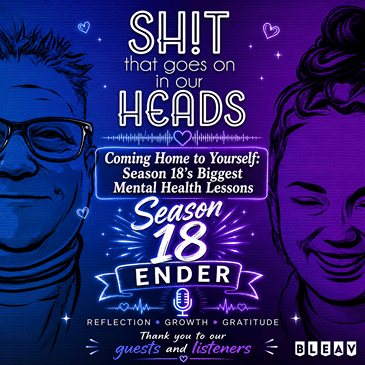
Season 18 reminded us that healing is not always about becoming someone new. Sometimes, it is about finding your way back to the person you were before trauma, shame, burnout, illness, or other people’s expectations pulled you away from yourself.
In this season-ender, G-Rex and Dirty Skittles look back at eight unforgettable guests, the lessons that stayed with them, and the conversations that changed how they think about anxiety, emotional healing, healthy masculinity, self-love, neurodivergence, food freedom, trauma, and listening to the body.
Awards and Downloads
Sh!t That Goes On In Our Heads is a 2024 People’s Choice Podcast Award Winner for Best Health, a 2024 Women in Podcasting Award Winner for Best Mental Health Podcast, a 2026 Podcast Tonight Award Winner for Best Mental Health Podcast, and a 2026 NYC Podcast Award Audience Choice Winner for Best Hosts, with more than 4.5 million downloads and listeners in more than 160 countries.
Feedback
We’d love to hear your thoughts. Leave us written or voice feedback here:
https://castfeedback.com/67521f0bde0b101c7b10442a
Mental Health Quote
“Healing isn’t about becoming someone new. It’s about coming home to the person you were before the world taught you to leave.” — Inspired by the guests of Season 18
Trigger Notice and Crisis Reminder
This episode includes conversations about suicide, suicidal thoughts, childhood sexual abuse, trauma, grief, serious illness, and mental health crises. Please take care of yourself while listening.
If you or someone you know is struggling or in crisis in the United States, call or text 988 to reach the 988 Suicide & Crisis Lifeline. https://988lifeline.org/
For crisis resources outside the United States: https://findahelpline.com/
Episode Description
Season 18 brought us eight guests with completely different stories, but one truth kept showing up: healing begins when we stop running from ourselves and start listening.
In this season-ender, G-Rex and Dirty Skittles revisit the conversations that changed how they think about mental health, parenting, masculinity, trauma, food, illness, self-worth, and the way the body carries what the mind tries to bury.
Nancy Gilette reminded us that behavior is communication and that connection needs to come before correction. Dr. Mark Sherwood showed us what it means to become a hope dealer, especially for people who feel forgotten or written off. Dominic Petty helped us see that peace is not some distant finish line. It is the baseline underneath the noise.
Jason Lange gave men permission to feel what is happening in their bodies and talk about it without shame. Michelle Petties challenged diet culture by showing us that food noise is often emotional noise in disguise. Michael Caprio proved that a life-changing diagnosis can become part of your story without becoming the end of it. Alan Katz showed us that telling yourself the truth can set you free, even decades later. Anat Peri reminded us that the only way to feel better is to get better at feeling.
G-Rex and Dirty Skittles also reflect on their own growth, the ridiculous lies anxiety tells us, and what happens when you finally answer that voice with two words: watch me.
This episode is honest, funny, emotional, and full of reminders that your body is not the enemy, your emotions are not weaknesses, and asking for help carries absolutely zero shame.
Keywords: mental health podcast, emotional healing, coming home to yourself, anxiety recovery, self-discovery, trauma healing, emotional wellness, healthy masculinity, neurodivergent parenting, food freedom, self-love, body awareness, emotional literacy, personal growth, mental health awareness
Meet Our Guests — Season 18
Season 18 featured eight guests with eight very different stories, but every conversation gave us one unforgettable lesson about healing, self-awareness, and finding our way back to ourselves.
Nancy Gilette
Nancy taught us that behavior is communication. Before we rush to correct, fix, or control someone, especially a child, we need to slow down, listen, and connect first.
Dr. Mark Sherwood
Mark reminded us that hope can be life-saving. Even the smallest glimmer of hope can interrupt the darkness and help someone believe that more is still possible.
Dominic Petty
Dominic taught us that peace is not something we have to chase. It already exists beneath the anxiety, the noise, and the emotional chaos. The work is learning how to return to it.
Jason Lange
Jason showed us that emotional strength begins with body awareness. When men learn to name what they feel and take responsibility for their pain, they are less likely to pass that pain on to the people they love.
Michelle Petties
Michelle taught us that food struggles are rarely just about food. Lasting change begins when we understand the emotions, beliefs, and unmet needs underneath the behavior.
Michael Caprio
Michael reminded us that a diagnosis can change your life without ending it. Gratitude does not erase pain, but it can help us build meaning, connection, and hope on the other side of it.
Alan Katz
Alan taught us that the truth can set us free, even decades later. Healing began when he stopped blaming himself for what happened and finally told his own story with honesty and compassion.
Anat Peri
Anat reminded us that the only way to feel better is to get better at feeling. Self-love grows when we stop running from our emotions and learn how to sit with ourselves without judgment.
Key Takeaways
- Healing is not always a reinvention. Sometimes, it is a return to the most honest version of yourself.
- The body is a messenger, not the enemy.
- Connection creates more change than shame or correction.
- Emotional literacy helps us understand what is happening inside us.
- Rock bottom can become a turning point, but asking for help should come sooner.
- Your worth does not depend on achievement, toughness, productivity, or perfection.
Actionable Items
- Ask yourself, “What is my body trying to tell me right now?”
- Replace broad words like “fine” or “stressed” with a more specific emotion.
- When anxiety says you cannot do something, answer it with evidence and two words: “Watch me.”
Important Chapters
- 00:00:37 — Welcome to the Season 18 Ender, celebrating 18 seasons with laughs and side quests.
- 00:05:17 — The Thread That Connected the Season: Finding your way back to yourself.
- 00:08:11 — Growth, Reassurance, and Reinvention: How the season changed G-Rex and Dirty Skittles.
- 00:11:09 — Nancy Gilette Connection before correction.
- 00:14:58 — Dr. Mark Sherwood Hope, vulnerability, and first responder mental health.
- 00:17:31 — Dominic Petty Inner peace, relationship healing, and baby spiders.
- 00:25:16 — Jason Lange Men’s groups, emotions, and healthy masculinity.
- 00:30:08 — Michelle Petties Food freedom and emotional eating.
- 00:33:20 — Michael Caprio Rare disease, gratitude, and resilience.
- 00:35:19 — Alan Katz Childhood trauma and telling yourself the truth.
- 00:37:14 — Anat Peri Self-love and learning to feel.
- 00:39:26 — Gratitude for the Season: Thanking the guests, listeners, and each other.
- 00:40:42 — What Anxiety Told G-Rex From “You won’t make it” to “Watch me.”
- 00:42:18 — Goodbye to Season 18: Closing out the season and welcoming Season 19.
Closing CTA
Subscribe, Rate, and Review!
Remember to subscribe for more inspiring stories. Rate and review us on your favorite podcast platform, or visit our website:
https://goesoninourheads.net/add-your-podcast-reviews
#MentalHealthPodcast #MentalHealthAwareness #Grex #DirtySkittles #Podmatch #ComingHomeToYourself #EmotionalHealing #SelfDiscovery #AnxietyRecovery #TraumaHealing #EmotionalWellness #HealthyMasculinity #MensMentalHealth #NeurodivergentParenting #FoodFreedom #SelfLoveJourney #EmotionalLiteracy #BodyAwareness #PersonalGrowth #HealingJourney
***************************************************************************
If You Need Support, Reach Out
If you or someone you know is facing mental health challenges, please don’t hesitate to reach out to a crisis hotline in your area. Remember, it’s OK not to be OK—talking to someone can make all the difference.
- United States: Call or Text 988 — 988lifeline.org
- Canada: Call or Text 988 — 988.ca
- Worldwide: Find a Helpline
- Mental Health Resources and Tools: The Help Hub
Stay Connected with G-Rex and Dirty Skittles
- Official Website: goesoninourheads.net
- Facebook: @shltthatgoesoninourheads
- Instagram: @grex_and_dirtyskittles
- LinkedIn: G-Rex and Dirty Skittles
- Join Our Newsletter: (https://grexanddirtyskittles.substack.com/)
- Merch Store: goesoninourheads.shop
Audio Editing by NJz Audio
Hosted by Simplecast, an AdsWizz company. See pcm.adswizz.com for information about our collection and use of personal data for advertising.
[00:00:01] Hey there, listeners. Welcome to Sh!t That Goes On In Our Heads, our podcast where we normalize conversations around mental health. That's right. I'm Dirty Skittles and alongside my amazing co-host, G-Rex, we're here to share stories and tips from our incredible guests. Each episode, we deep dive into struggles and triumphs of mental health, offering practical advice and heartfelt support because no one should feel alone in their journey.
[00:00:31] Join us as we break the stigma and build a community of understanding and compassion. Tune in and let's start talking about the shit that goes on in our heads. In three, two, one. Welcome back to another episode of Sh!t That Goes On In Our Heads. I'm here with the awesome Dirty Skittles today and every day that we record. Wouldn't have it any other way.
[00:00:57] And today we are recording our season 18 ender. How the fuck did this happen? We're 18. We are 18 years old, not quite 21. Yeah. But you know what? We are now like legalized, like legal adults now. Legalized like. Like how anybody made that decision that 18 you're an adult. Yeah. Yeah. Where were you at 18? Oh, you don't want to know.
[00:01:28] Probably drunk or stoned. Oh, wait, I was still in high school. You probably would have just been graduating. I would have getting. Oh, yeah. At eight. No. By the time I graduated, I was almost 19. No shit. Yeah. I was held back. How fucking dare they? What school was that? Let's send a memo. I fuck. I don't know. But I remember I was tiny. Oh. Like I was short for my age. And you know what? I didn't mind being held back. It was fine.
[00:01:57] I was smarter than everybody else in my classes. I'm like, yeah, whatever. And let me go buy you some beer. Okay. Oh. Because back in the day, 18 was the drinking age. Well. And in Colorado, it was 3.2 beer. Like why? Why drink that beer? It was all water. 3.2 beer. Oh, like alcohol content. Alcohol content. Oh. I thought you were saying you could only buy 3.2 beers. Yeah. I was like, huh.
[00:02:27] Okay. I should have been held back. Oh, man. It only took me how many seconds to break you on this episode? A minute. Like about a minute. We're a minute in and I'm already like laughing my ass off because you're a dingled dork. A dingled dork. Love it. Dingled dork. Yeah. Because you know what? You bring out the worst of me in two different ways.
[00:02:56] But like in good ways. So you bring out the like laughter and humor and like deep thinking on this podcast. Mm-hmm. But on our other podcast, Paperback Confessions, you bring out the very feral side of me. And like that's a side that like a whole lot of people don't normally see because I like reserve that for a certain audience. But you know, you and Nacho and I, we just have a good time with that. And that's my form of escapism.
[00:03:27] Yeah. I mean different kind, but. Way different kind. Way. Yeah. 18. I was graduating high school. I was just like a square. You know what I'm saying? I was like, gotta graduate high school and then go straight to college. So I wasn't doing anything crazy. And I don't think I could buy alcohol then. When did they change the age from 18 to 21? I don't know. There's a 20 year difference between us. So I have no freaking idea.
[00:03:55] It's probably for the, I mean, I did start drinking when I was 13. So. I mean, I didn't need the 21 to make that decision. Didn't need the legalese of that. But when did you graduate high school? 1999. Holy fuck. And now we're gonna party like it's 1999. I graduated in 82. I was born in 81. Holy. Fuck. I feel old now. Why?
[00:04:25] I feel like a, well, actually I don't feel young. I'm going to be honest with you. I was about to say, oh, I feel like a little baby. No, I don't. I don't. It's really sad now when you go to put your age in things and you have to like scroll one page, scroll another. I'm like, who's born in the 2000s? I don't know. Try doing that for 1963. Okay. It's like, it's remember on Wheel of Fortune, not Wheel of Fortune. Price is right. Where they go and spin that wheel. Yes. Shit. It's still spinning by the time I get down to where I need to go.
[00:04:55] I was going to say Rolodex, but you went Wheel of Fortune. Whatever, Wheel of Fortune. Listen, let me just type the number in. Okay? Because I don't want to scroll through your shit to do this. It's too long. Too long. Yeah. I was graduating high school. Going straight into college. No, no break. Just whoop. There we go. You're a little freak, but I love you for this. Yeah. And we had such a good season, right?
[00:05:23] Like, we had really good guests and we both learned a lot. We learned a lot. And I will say this every time we do a season ender. Every time we record with somebody, I learned something new about myself. Yeah. It's the same. And I was just thinking like, we say this all the time that there's like a thread. What do you know? What's the other word I'm looking for? A fucking common denominator between all. But like this one, I actually had a hard time picking it out.
[00:05:52] So I fell onto self-discovery or maybe not even self-discovery. Learning how to listen to yourself. I feel like that went through. Yeah. And kind of like finding your way back to yourself, right? Yeah. Because like we all have these preconceived notions of like what our life is supposed to look like. But you know, sometimes fate or a matter of circumstance makes us take a step back. Yes. And figure out what's really important. Yeah.
[00:06:21] And I think that's what I found from this season is like, it's okay to take that step back and like figure out like who you are. Mm-hmm. Because we're not the same person we were 20 years ago. We're not the same person we were five years ago. I'm definitely not the same person I was three years ago. Yeah. And like the same for you. Like I've seen the growth in you over like just the last year. Yeah.
[00:06:49] After all the shit you went through with your own mental health. And like, I'm so fucking proud of you. I'm proud of you, dude. Look at you. Look at you. Look at you. Look at us. Like, you know, I'm out here living my best fucking life. I really am. I'm in. I don't give two fucks about a whole lot of shit right now. Mm-hmm. But I get to do the things that I love. And I'm not out there pleasing everybody else.
[00:07:19] And, you know, if you don't like me, I don't fucking care anymore. Okay? No. Time's not on my side anymore. So if you don't like me now, I don't care. I don't really know. And, you know, I learned about self-preservation. And we got to really talk about mental health because that's not something that's talked about enough.
[00:07:45] And, you know, how everything ties together like autism and burnout and medicine and relationship. It's everything. You know, when people get diagnosed with a rare disease or if childhood trauma or self-love, like, it all kind of comes back to, like, how I've lived my life up until this point. Yeah.
[00:08:12] I also learned this season, it was a lot of reassurance, like, some of the choices you are making. I think in the moment you're, like, hoping it's the right choice. And then through hearing the stories that were shared this season from our guests, it was definitely reassuring that, like, you know what, you are making the right choice. And you touched briefly on men's mental health, which was a pretty big topic this... Well, for us, it was a big topic because June is Men's Mental Health Month, right? Yep. Did I say that right? Men's Mental Health Month. Woo!
[00:08:41] Can you say that, like, 42 times really fast? Nope. Nope. But I'm a mother of a boy. And so that was very reassuring to me to hear what, from the men guests, what a healthy version of masculinity is. And it was very reassuring that where I'm going with my child and how my husband and I are raising him, that we are making the right choices. So there was a lot of that this season, which... Shit.
[00:09:10] I'm so grateful that we are still doing this 18 seasons later. Yeah. So grateful. Same here. I'm still learning about myself because I basically reinvented myself. You did. Yeah. On, you know, December 26, 2023.
[00:09:39] Because it was from that day forward, I made that decision. I was never going to go back to where I was prior. Yeah. And these conversations just remind me of how important it is to do that. I wish I could, I wish I wrote the date down that you and I were having a conversation off air and you had said to me, you know, I realized I'm more than just my story. And I remember thinking like, whoa, I think I called it out.
[00:10:08] I'm like, that is such huge growth. Because I think when we started the podcast was a very different time than where we are now and seeing your growth. And just that one statement, like I was like, wow, this is amazing. And selfishly, I get to witness it when we record. And that's what makes us fun, right? And, you know, I still have people reaching out to me from other podcasts that I've been on.
[00:10:36] And they're like, your story really resonated with me. And thank you for sharing that. And that's why this podcast is still super important. Because every time we share our stories, we help somebody else out. Yeah. Right. There's still so much stigma and shame. And I'm going to keep saying there's absolutely zero weakness and zero shame in asking for help. Yeah. And we could not do this or spread this message without the guests that we have.
[00:11:06] So season 18. Yeah. Let's talk about our guests. We started, well, we hit the ground running with Nancy. Oh, my God. That's the episode that your eyes just got wild. And you're like, suck. Like, maybe I do have a little bit of autism. And we were talking about this because, you know, like there's no cure. Right. And like, we are who we are.
[00:11:35] And like, I don't give a crap. Maybe I am a little autistic. Right. You know what? It makes me who I am. It's this flavor of G-Rex that people get to see now. It's even more evident now, though, that I worked for myself than when I worked for another company. Right. Because now it's a lot of days of just talking to myself and being like, oh, that was kind of a shit show. Let's try this. Let's try this a different way.
[00:12:05] That's so interesting. Yeah, I noticed the ADHD, too. Way more now than I ever did. I'm like, oh, look, silver squirrel. Let me go follow that. Oh, shit. Did I do my billing?
[00:12:18] But the thing that Nancy did, and I think that it's so great, the support that she gives for parents that have neurodivergent kids is like giving them permission to fucking just take a break and be a little kinder to yourself. Right.
[00:12:37] That's, yes, I remember sitting across and being like, oh, and I think for me, it was because I could understand what my son is feeling in certain moments because I myself feel that way. And so talking with Nancy was that moment of realization like, oh, this isn't just like a mom and a son bonding because they're mom and son.
[00:13:00] It was because there is that piece of me that I oftentimes I wonder, dude, I got some real weird quirks that literally prevent me from operating if I don't take care of them. And so I can pick that up in him because he's the same. I mean, we have moments where we need to be understood.
[00:13:21] And I'm very fortunate to be able to speak with guests like Nancy, who helped me realize what it is and to have a son that I can bond with over it. Yeah. She gave us, gave you, gave parents permission to, you know, take care of yourselves too. Yeah.
[00:13:38] And, you know, be okay with like learning more about, you know, being neurodivergent and also, you know, the fact that she has Crohn disease and, you know, other autoimmune conditions that can really like fuck you up, right? As a parent. And she reminded me that behavior is communication. And the first job of a parent isn't to fix it, it's to hear it. Yeah.
[00:14:05] So as long as you're like listening to your kids, whether it's nonverbal cues or whatever, I mean, that is your number one job. Yeah. And learning how to communicate with your kids. Yes. Because they're learning from you. So you need to say what you mean. And, you know, just remember kids are, they're like little parents. They will mimic your behavior. So just take that minute to like step away, take time for yourself. Yeah.
[00:14:33] If you're making coffee in the morning and you're feeling overwhelmed and you're about to lose your shit and snap, it's okay to say, hey, I need like 10 minutes. I'll be right back. I need to like regulate myself and I will return. I'm going to go out to the garage and beat things and then I'll be back. And we're good. Yeah. So Nancy, thank you. You did me good. You done taught me something on that one. We all learned a little bit of something from her.
[00:15:01] And then we had like Dr. Mark Sherwood and he was the hope dealer. And like he, he gave me the goosebumps. Oh, yeah. Because he gives all of his patients that little bit of hope, right? Yeah. That things are going to be okay. And, you know, we've had a couple of guests on the podcast that have been gaslit so bad by the medical system.
[00:15:26] To know that there is a, that there are doctors out there that are really trying to give their patients hope. That, that warmed my heart. So. Yeah. And I know it's scary to get to a place in your life where you don't have hope. I think that's when it becomes very dangerous.
[00:15:47] So, so knowing that there are people out there like Mark who know just how important it is to be able to share that with other people. Like I, I'm always in awe of our guests or I'm just like, wow, you know, you are out here just doing this self, selflessly for others. And it's such a huge thing that you're trying. It's like a huge mountain you're trying to climb.
[00:16:12] But when there's people out there like that delivering hope and helping people get into that safe space, it's so beautiful. I think the other beautiful thing that he's doing is, you know, helping with first responders because the suicide rate for first responders is through the roof. Yeah.
[00:16:34] And just, you know, think about what police officers and EMTs and firefighters see every day and, you know, letting them know that it's okay to like check in and get some help. And, you know, he was a SWAT officer, right? And like he's seen it all.
[00:16:52] And I just love how he, how he's dealing with everything, especially after his mother, you know, died by suicide and how he just wants to make people feel seen, heard and valued. And I give it to him. Like we need more doctors like him in this world. Yeah. I love that he was vulnerable with us. And because like you think, right, like you hear like SWAT officer and you're like, oh. Badass. Yeah.
[00:17:20] This was like a fucking wall of a person we're about to meet. But no, like he was vulnerable and very sensitive. And I loved it. To me, that's healthy masculinity. Yeah. Super healthy masculinity. And then, you know, the next guest we had was Dominic, right? We had a lot of men on this season, which was perfect because, you know, like we said, June was men's mental health month. And it doesn't always like pan out this way, but I'm getting better with scheduling.
[00:17:52] You're doing the Lord's work, G. You really are. Not all heroes wear capes. Joe, I can't talk today. It's the Red Bull, guys. It's the Red Bull, the coffee. The five-hour. The Adriel. The one-hinged. Yeah. Sleeping with spiders. Oh, that could be a fun book. Sleeping with spiders. What would it be about? Horror? Romance? Self-discovery?
[00:18:21] Addiction recovery? Sleeping with spiders. The mental health aspect of a spider climbing on me all night long? Yeah, no. A bunch of little baby spiders is what happened, listeners. We returned from a couple weeks away to an empty house that smelled like an antique store. And I spent hours just bleaching everything and cleaning it up and then go to bed in fresh sheets. And I'm like, it feels like I'm just, things are crawling on me.
[00:18:50] I was right. Little baby spiders. Okay. At that point, I'm just going to tell you, if it'd been me, we're going to light those sheets on fire. And then- I washed them three times. I don't care. I'm going to go find a 24-hour open target and I'm going to go get one of those insecticide bombs and I'm going to let that shit off in my bedroom and I will sleep on the couch.
[00:19:17] Oh, listen, my husband sent, he's like, this stuff is going to get there because he's still away. He's like, this stuff is going to get there. You got to put it on a plate and then put the plates somewhere the dogs can't reach. And I'm like, dude, brother, just light it on fire. You know? You know what's going to kill spiders? Flame. Fire. Yeah. That's what's going to kill it. Flames. Wow. We side quested real quick. We did. How did we get here again? Because we were talking. Honestly.
[00:19:47] But you know, a lot about like healing relationships. Trauma. And that's how we got here. And finding your inner peace. I mean, like, how the fuck did you find your inner peace with that? Because I am telling you, I would not know. I'm such a lightweight. Literally, this is what happened. So, sorry guys. We're going to side quest again. Because this kind of ties into an earlier, I guess, that we had in the season where Nancy, where I thought I was like, oh, maybe I got a touch of the tism or something.
[00:20:16] So, the reason I kept re-washing my sheets instead of just getting a new set is because I was like, I don't know where the spiders are coming from. There's no guarantee that I'm going to grab another set of sheets from like the linen closet. Maybe that's where the spiders are. And now I'm just reintroducing a new batch of spiders. So, I washed the sheets again in bleach and thought, maybe I got to do it one more time. Because I don't know, maybe they're in the fibers. So, I did it again. It was a problem.
[00:20:43] But the inner peace, to answer your question, came from, shout out to my mother-in-law, God bless her. Every time she comes and visits, she stocks our little mini fridge in the laundry room with different types of beer. And so, I was like, I need something to take the edge off. But I'm not going to do a shot of tequila at like 11 p.m. So, there was these like Corona 90 calorie, whatever the fuck they are.
[00:21:12] I was like, sweet, pop open this bitch, pour in lime juice, chugging this. Knocked right out. So, if the spiders came back, I don't know where they are now. I'm sorry, I'm fucking dying here. I'm dying. But like in the best possible way possible, I'm telling you, if I'd been in the house with you, your husband would come home and that whole like little room would be like charred. Yeah.
[00:21:43] What's that smell of incense? Incense and maybe some burned down. Burning patchouli over here. And maybe some burned down walls. Yeah. We used your flamethrower. You're not spiders. Your clothes are done now. We need to go shopping. Anyways, sorry. Sorry for the side quest. Yes, Dominic. Inner peace. Yeah, we need some of that.
[00:22:09] What surprised me the most about him is like he is a tech guy, right? He is like highly educated and he's worked for a bunch of tech firms, but he kind of stepped away from that. Yeah. Because he was having all this trauma from relationships and like self-acceptance. I can't talk today. Self-acceptance and like finding his inner peace. Yes.
[00:22:38] Because you know what? We all know what it's like. Not all of you, but if you've worked in a tech environment, it's high stress every single day. And I loved that he was, you know, able to just pull the shit together. And like he's out there like mentoring people now and, you know, being the inner peace advisor. And he was very calm, cool and collective. Yes.
[00:23:07] But I like, I remember me just being fascinated by his brain because we have worked with engineers before. And I will tell you guys, if you've ever watched your show Silicon Valley, very close to like the mentality of an engineer. And he was super insightful, super calm. I remember him mentioning his friends would tell him like their relationship problems all the time, which the engineers I work with are not like that at all. They're very much like just A to B.
[00:23:35] Like, what's the problem here? But he was very much like trying to crack the code of like human existence and emotions. And yeah, everybody has a baseline. Like, let's just figure out how to get you there. And like coaching people through it, which I was like, wow. I would love that. And catching people, you know, make them feel seen in their own bodies, right? Yeah. Accepting like what's going on and like, how do you work through this? And how do you make yourself feel better?
[00:24:04] And so I really liked it. And from just a software standpoint, like a software engineer standpoint, because I've worked with him my entire career. Awesome. He was very eloquent and very well spoken. Yes. Yes. Yeah. I know exactly what you mean. I know exactly what you mean. And he just, he put me at ease. Like the kind of person you want in a moment of like emergency. Yeah.
[00:24:32] Like if we could have like someone like him in every single war room, every time software breaks, like he would be like the peacekeeper. Yeah. And for our listeners who don't know what a war room is, a war room sounds really intense, but it's essentially just like a meeting that occurs between all product. Well, all related product engineers, sometimes security, depending on what the issue is that happens in software.
[00:24:59] And it's a conversation between all those people and what's going on and how do we fix it. And sometimes there's a lot of yelling and maybe some cursing, but like that, you know. Yeah. It's usually when somebody forgets to mute their mic and then they're like, oh, fucking day this fucking trip. Oops. Forgot to mute my mic. That could have been me back in the day, but you know, I won't take responsibility for that.
[00:25:26] But then we had Jason Ling and I am so thankful for his fraternity brothers for finding him. He, you know, he also tried to take his life while he was in college. And like I said, thank God for his fraternity brothers who found him, got him the help that he needed. And he has made it his life's work now.
[00:25:55] To make sure that people have the mental health resources that they need. Not just individuals, but companies, schools, everybody. And very, another super well-spoken. And, you know, he was just, he just made me feel good. Yeah. And I feel like his story is so relatable.
[00:26:21] And the fact that he's taking his experience and what, what helped him, like the whole men's groups and, is that what it's called? Men's groups? Them getting together and being able to learn and teach each other. Yes. And no, this is for you. You need to erase what I said because wrong guest. Let me mark this. Well, you started saying that and then I'm like, wait, I thought it was the other guy.
[00:26:51] I'm like, I don't, my memory's shit. So. Yeah. I'll edit this before I send it. But what I did love about him is like, he didn't have that connection with his dad. Right. He didn't know how to ask for, how to ask for help. And so when he started like forming these men's groups and getting, getting questions and getting, you know, being able to ask questions and not feeling bad about asking questions. And so, like he said, like every man needs a men's group. And that's true.
[00:27:20] And, but like, as I was growing up, I don't think I ever remember my dad or, you know, my grandfathers ever in a men's group. And I think it was something that's come to fruition over the last, you know, 10, 15 years. Yeah. I mean, he helped me understand a lot there. So I remember when I said that there was a lot in this season that made me, it was very reassuring.
[00:27:46] And I remember sharing with him, you know, how frustrated I get because I would hear, well, you're, you know, your son is just so sensitive. Just so sensitive. And for me, that kind of bothers me because I, as a mom, I went out of my way to sort of make sure that he could identify emotions and be able to give it a name and feel those things. But more importantly, be able to move through them and not just get stuck in the emotion.
[00:28:15] And hearing about a men's group, I can only like associate what I see in movies, which is like guys in the woods yelling at a fire. Right? Yeah. Like what is a men's group? Like, how can that be important for a man? But it made sense talking with him, you know, it's like men around men talking about emotions and working through that together in a language that they understand.
[00:28:41] And so I remember him saying, you know, because I'm like, how do I basically instill that sort of level of confidence in my son? So that when people say he's so sensitive, he doesn't, you know, change. I don't want him to change. And he talked about, you know, father and son groups and making sure that male presence is there because it's important to be able, as a guy, to communicate with other men and learn from other men.
[00:29:22] I can see what happens between Bizzle and Nugget, right? Bizzle's a really good dad. He is totally in Nugget's life. And, you know, maybe as Nugget gets older, this might be like an avenue for them also, right? And just so that they can know that it's okay to express your emotions and, you know, maybe not turn out to be a narcissist or a misogynist or like gaslight people around you, right? Yeah.
[00:29:51] And I think that's how some of these men groups, men's groups can help other men is like how to turn those horrible characteristics off. Yeah. And just be a good person. Yeah. Learn from a healthy man how to be a healthy man. Yeah. Makes sense. Makes sense. So after Jason, we went into Michelle. She was so funny.
[00:30:17] That was such a great conversation about, you know, how she had lost, you know, gained and lost over 700 pounds and yo-yo dieting. And yeah, like now she's like, you know what? Fuck it. I'm just not going to like do this yo-yo dieting anymore. And really got into the science of like how emotions and things play into what comes into our body. Yeah. And like learning.
[00:30:48] Oh, God. It's like learning how to have a healthy relationship with food. Learning that there is. You know what it is? Learning that there is a relationship with food. Yes. How to make it healthier. And I remember I'm an emotional eater. I guess, well, kind of. You want that comfort. So you go to those comfort meals. But I also will eat if I'm bored. I'm going to have to question myself. Are you hungry or are you bored? And that is really shitty when you're trying to diet and trying to eat healthy and trying to, you know, lose weight and have a healthy relationship with food.
[00:31:17] It's like, dude, it's super, super difficult. So, yeah, to your point, she was very funny. And I remember like sitting across from her and being like, oh, this is like a real person who like understands the struggle. And like, yeah, it's crazy, man. Like, why does it have to be so hard, though? It does. And it is hard. Like the other day, I was a little stressed out. And like you, I'm a stress eater. Mm-hmm.
[00:31:43] And so I had a half a bag of Cheetos and some Reese's sticks because I needed that comfort food. I need the crunchy food because I was a little mad at myself. And then I needed the sweet food because my brain was like, maybe this will make me feel better. Neither of them made me feel any better. Yeah. But I then did go and have ice cream after that. And that kind of made me feel better.
[00:32:08] Yeah, I remember her saying like before she would eat, she would like question the food. Is it going to serve her? Like what? And it made sense. I'm like, what is this food going to give me that will make me feel better? Yeah. And it's not just like, well, it's chocolate. Enough said. It's like, no, am I going to feel better after I eat this? Am I going to feel like, is this really what I want to put in my mouth? Yes.
[00:32:36] So she made me kind of think about like just the whole diet culture that we have going on right now and like how everybody is like trying to be thin and like the psychology that goes into that. Me, I'm like, listen, you know what? I've lost over 100 pounds since we moved up here. I'm just making better choices now. Yes. Make better choices. Make better choices. I mean, should I have that Coke in the morning? Probably not. But you know what?
[00:33:05] It's that or coffee. In the summertime, it's Coke. In the winter, it's coffee. So I said, I need to cool off. Those are your rules. Those are the rules. In the winter, we have something hot. In the summer, we have something cold. Yeah. I hear you, bud. Then we went into Michael. Oh my God. What a story. And it was heart-wrenching. But to see how amazing he looks now. Yeah. Yeah. And he seemed so happy. Yeah.
[00:33:35] And like so full of gratitude. Yeah. Yeah. After a tough diagnosis and living life and trying to figure out what it's going to look like after that. And like, again, these are like one of those things where you hear somebody's story and you think to yourself like, man, how did they get through that? Like if that was me, I wouldn't be so put together and well-spoken and grateful for the life that you have. It's hard not to crumble.
[00:34:04] I think you might though. Because, you know, after 18 seasons, we've learned from people how to be grateful. How to kind of just walk into this and be like, yeah, I don't want to be gaslit. Tell me what I need to know. And even if it's hard stuff and the fact that, you know, both his mom and his grandma had this disease. Same thing. Same thing.
[00:34:30] But like how shitty to get that news at like when you're 18. Yeah. You're young. You're discovering yourself still. And then all of a sudden, boom. Hey, by the way, you're going to have this really difficult hurdle that you'll have to like get over for the rest of your life. And it was really tough.
[00:34:50] But like I could see and I could hear the gratitude when he was, you know, speaking and how all the doctors and nurses and his family all came together. And rallied around him to, you know, just make sure he was doing okay. Yeah. And he had a good sense of humor about it. He certainly did. We laughed quite a bit in that episode. Because I'm poor. Well, I think we're all kind of young at heart, you know. We are.
[00:35:20] And then we had Alan. Alan, we love you. But boy, could you talk. We need him back. We do need him back. I was so fascinated by all the stories and the industry and all that, that I was like, there's no way that this is going to. No, he's going to have he's we're going to have him back on. But, you know what? You know how we talked about like coming back to ourselves. Yeah.
[00:35:45] He it took him 45 years to finally dive into what had been bothering him forever. Right. You know, he had been sexually molested and he kept blaming himself. And then he finally like got into therapy. And he's now gotten to that point where he can forgive himself because it wasn't his fault. No.
[00:36:14] And I just it was fascinating to listen to him talk about how he got into showbiz and how he, you know, has like specific mood stabilizers that help him just kind of have that even flow. I'm going to tell you, people at our age, like I am not. If you need a mood stabilizer, like do it.
[00:36:37] Because it's great to just be able to like sit in life and have that that steady stream instead of this huge anxiety or the deep lows. Fortunately for me, I didn't take medication. I self-medicate with a little bit of THC and CBD when I need to. But I also know what will get, what will give me a huge amount of anxiety or will make me super depressed so I stay away from that shit on purpose.
[00:37:07] Gotta learn. Gotta learn somewhere. Gotta learn. We all gotta learn. Yeah. And then after Alan, we went to a knot. And we did. And it was all about self-love and taking care of herself and like rewriting your story. And, you know, we both know what it's like to rewrite our story. I rewrote mine. The last year, you've been rewriting yours. Yeah. Yeah.
[00:37:35] And I love the idea of dating yourself. Yeah. As she shared, like going out and that's... Yeah. I honestly, I'm like thinking now and I probably like I had shared with you just before we started recording. Now I came home and sort of preparing the house. So we've been on away from home for a while and eating dinner by myself and how I almost cried. And I think in the moment with you, I was like, well, it was so calm. I'm like quiet.
[00:38:04] But you know what it was? It was a learning to be with yourself and like, hey, old friend. It's been a while since we've checked in. It was like that, but it was me with myself. And she, I remember her touching on that. Like learning what it's like to be with you and taking yourself out on a date and treating yourself well. And yeah, there's beautiful. There's beauty in that. Like I did that for myself the other day, you know, because as an adult, now I can have dessert for dinner. You can make those adult choices. I can make those adult choices.
[00:38:34] And so the other day I took myself on a little ice cream date and it was just that little bit of self-love that I needed. Maybe I didn't need the ice cream, but I wanted it. And, you know, if you live in the upper Northeast, like ice cream is a big thing during the summer months. Actually from April to about October, because all the local farmers, they get their milk to the little ice cream shops.
[00:39:04] So it's like filling my belly full of love. And I, you know, that's one of my forms of self-love is just trying to get out and be happy for myself of where I am in my life right now. Yeah. You're getting out of the house. You're changing the scenery. You're enjoying being outside. Yes. And a little tasty treat. A little tasty treat. It was delicious.
[00:39:29] And I'm just going to say, like, thank you to all of the guests that we had on this season. We learned so much from all of you. Yeah. Yeah. We couldn't be doing this show without you guys. And I hope that our listeners are able to hear your stories and take something away from it or find you afterwards, whether it's a book or your websites. Just thank you guys for sharing up. Yeah. And, you know, Dirty Skittles, you know, just thank you for showing up for every recording.
[00:40:00] You're for showing up. Not just showing up, but like, thank you for making me think and like get a little bit outside of my own normal stuff. Right? I hear you. I will tell you, like working for myself, it's a little wild sometimes. But, you know, you're always like checking in to make sure that I'm okay and that I don't have too much on my plate. And, you know, I'm my own worst enemy because I say yes to everything. But I'm getting better.
[00:40:28] And the fact that, you know, I consider you like my extremely best friend. Oh, man. Like taking that from you is like my mom's yelling at me. So, you know, I'm okay with it. I'm really okay with it. All right, G. Your last question. Yes. Because you like to ask our guests if their anxiety had theme song, what would it be? My question's a little spin on that. Okay.
[00:40:54] What is the most ridiculous thing your anxiety has convinced you is true? My anxiety. So the most ridiculous thing would have been that I'm not going to make it on my own. That's what my anxiety was telling me. Of course, I don't change within a year of being in business.
[00:41:22] But that's what my anxiety was doing to me. It kept telling me that I wasn't good enough. That I wasn't enough. And I knew in my head that I am. I've worked really hard to get where I'm at. And so that's like what stupid anxiety does for me. Nice. Okay. What would you tell anxiety now? That same voice that you heard? I would tell that anxiety to watch me. Okay. Nice.
[00:41:50] Like, I go back and see where I was a year ago when I started my business and where I am now. I made it. And anxiety or not. Because I were, you know, I am by myself. And I'm kind of dependent on like the decisions I make and or don't make. And yeah, I took a chance on myself and I was like, fuck you. It's either going to work or it's not. And it did. Yay. Thank you. Well, thank you.
[00:42:19] So we'll all see you guys for season 19. Yeah. Coming up next week. And thank you to all the listeners, the guests, all our supporters, especially our family and friends. And take care of yourself, dude. Take care of yourself. Bye. Bye. Bye, all. Thank you so much for listening to this episode. I'm G-Rex. And I'm Dirty Skittles. Don't forget to subscribe, rate, and review this podcast. We'd love to listen to your feedback. We can't do this without you guys.
[00:42:57] It's okay to be not okay. Just make sure you're talking to someone.